Amazon Ads
Amazon DSP Explained: What It Is & How to Start
If you searched "Amazon DSP" and landed on a page about delivery vans, you're not alone. In typical Amazon fashion, the acronym does double duty: there's Amazon Delivery Service Provider (the logistics program) and Amazon DSP — the Demand-Side Platform. This post is about the second one: Amazon's programmatic tool for serving display and video ads both on and off Amazon. If you're a brand already running ads and wondering whether DSP is your next move, here's what it is, who it's for, and how to get started.
Key takeaways
- Amazon DSP is audience-based programmatic advertising — display, video, and audio — that runs on and off Amazon and is billed on a CPM (cost per 1,000 impressions) basis.
- It complements query-based PPC; it is not a replacement for Sponsored Products or Sponsored Brands.
- You are ready when you have a profitable PPC engine and at least one product with 100+ reviews. Budget DSP at roughly 20–25% of PPC spend.
- Three ways in: Amazon self-service (no formal minimum), Amazon managed service (~$50k/mo minimum), or an agency (often ~$5k/mo).
What Amazon DSP Actually Is
At its most basic level, Amazon DSP is display advertising — both static and video — that can serve in a range of sizes and placements on Amazon and across the open web. If you sell on Amazon, there are creative formats that pull images straight from your product detail page into the ad, so you can get up and running without a design team.
Under the hood, DSP is a programmatic platform: it buys impressions through real-time bidding (RTB), competing for the right shopper in milliseconds rather than bidding on a keyword. What makes Amazon's version unique is the data behind it — DSP taps Amazon's first-party shopping signals (what people browse, view, and buy) to build audiences you can't replicate anywhere else. And because it runs across the full funnel — awareness, consideration, and conversion — DSP can both introduce your brand to new shoppers and pull warm ones back to purchase.
The clearest way to understand DSP is as the other side of the advertising coin from Amazon PPC. Where PPC is query-based — you bid on what someone types into the search bar — DSP is audience-based. It targets people according to how they browse and buy, either in real time or historically, on a per-shopper basis. And instead of paying per click, DSP is billed on a CPM basis (cost per mille — cost per 1,000 impressions).
The one-line version: PPC chases the search query. DSP chases the shopper. The most common starting point is retargeting — showing your product again to people who viewed it but didn't buy.
PPC vs. DSP at a Glance
Who Amazon DSP Is For — and When You're Ready
DSP can be used by brands that sell on Amazon and brands that don't. We'll focus here on the former. The honest answer to "is it for me?" is usually not yet, but soon — and the timing matters more than people think.
DSP is an extension of a profitable ad structure, not a replacement for it. It is not a substitute for Sponsored Products or Sponsored Brands; it's the layer you add once those are pulling their weight. In the accounts SellTru manages, Amazon Ads typically drive 30–60% of total revenue, depending on the category, the age of the account, and how cemented the brand is in its niche. A healthy account is usually running around a 20–30% ACoS, with TACoS in the 10–15% range — sometimes closer to 20% for a subscription or reorder-driven product. Get that engine profitable first; DSP amplifies what's already working, and it will just as faithfully amplify what isn't.
Two practical readiness checks we use:
- At least one product with 100+ reviews. Below that, conversion rates rarely justify the spend. The closer to 1,000 reviews, the better DSP tends to perform.
- Meaningful PPC spend already in place. We generally run DSP at roughly 20–25% of PPC spend, so if your PPC budget is small, it's too early to experiment.
How DSP Targeting Works
This is where DSP gets interesting. Amazon offers something like 15,000 pre-built audiences, but the real power is in custom audiences. You can take any ASIN — yours or a competitor's — and build an audience from views, purchases, searches, similar-product views, or Subscribe & Save, with a look-back window you control.
A few of the most effective plays:
- Retargeting (the simplest start): Target shoppers who viewed your product, and negate the ones who already purchased. That negation is unique to DSP and quietly important — you stop paying to advertise to people who already bought. Set the window to however long your buying cycle runs: 14 days, 30 days, whatever fits.
- Competitor conquesting: Build audiences from competitor ASINs — people who viewed or browsed a rival product — and show them yours instead.
- Cross-selling: If you have a broad catalog, target buyers of one product and serve them another to lift customer lifetime value.
- Contextual targeting: Unlike audience targeting (which is historical), contextual targeting works in real time — placing ads on specific product detail pages, categories, or related products as people browse them.
Two more levers worth knowing as you scale. Amazon's in-market and lifestyle audiences are pre-built segments — large pools of shoppers Amazon has already flagged as actively shopping a category — that you can layer onto your targeting. And for advanced advertisers, Amazon Marketing Cloud (AMC) lets you measure how DSP and PPC work together across the customer journey, then build custom audiences from those insights. You don't need AMC on day one, but it's the ceiling DSP eventually unlocks.
Where DSP Ads Actually Show
DSP serves across far more real estate than PPC. The easiest entry point is the responsive ecommerce ad — all you need is an ASIN, and the creative adapts to 18 different sizes across placements both on and off Amazon. From there the inventory opens up fast:
- Amazon-owned properties: the homepage, product detail pages, and apps like IMDb, Twitch, and the Amazon shopping app.
- Streaming TV & online video: ads on Prime Video, Fire TV, and Twitch, plus video across the web — premium placements that used to be reserved for big-budget TV buys.
- Audio: spots on ad-supported Amazon Music and podcasts.
- The open web: third-party sites and apps reached through Amazon's supply-side partnerships, still powered by Amazon's audience data.
Most brands start with responsive display retargeting and expand into video once the foundation is proven — but it helps to know the full canvas DSP gives you.
Amazon DSP vs. Sponsored Display: What's the Difference?
This trips up almost everyone. Sponsored Display lives inside Seller Central, is billed per click, and offers a simplified slice of audience and product targeting — it's the on-ramp version. Amazon DSP is the full programmatic platform: far deeper audience controls, CPM billing, video and audio inventory, and reach across the open web. Think of Sponsored Display as DSP's training wheels.
If that on-ramp version sounds like the right scale for you, we wrote a dedicated guide to Amazon Sponsored Display ads — the campaigns worth running and the settings that matter.
| Sponsored Products / Brands | Sponsored Display | Amazon DSP | |
|---|---|---|---|
| Targeting | Keywords / queries | Basic audiences & products | Advanced custom audiences |
| Billing | CPC (per click) | CPC (per click) | CPM (per 1,000 views) |
| Access | Seller Central | Seller Central | DSP console / agency |
| Formats | Search ads | Display | Display, video, audio |
| Reach | On Amazon | On & off Amazon (limited) | On & off Amazon (full) |
What DSP Looks Like in Practice
These benchmarks aren't theoretical. After SellTru took over one brand's Amazon advertising — Sponsored Products, Sponsored Brands, and DSP working together — product sales grew 39% year over year, reaching $617.5K in trailing-30-day sales while the account stayed healthy and profitable.
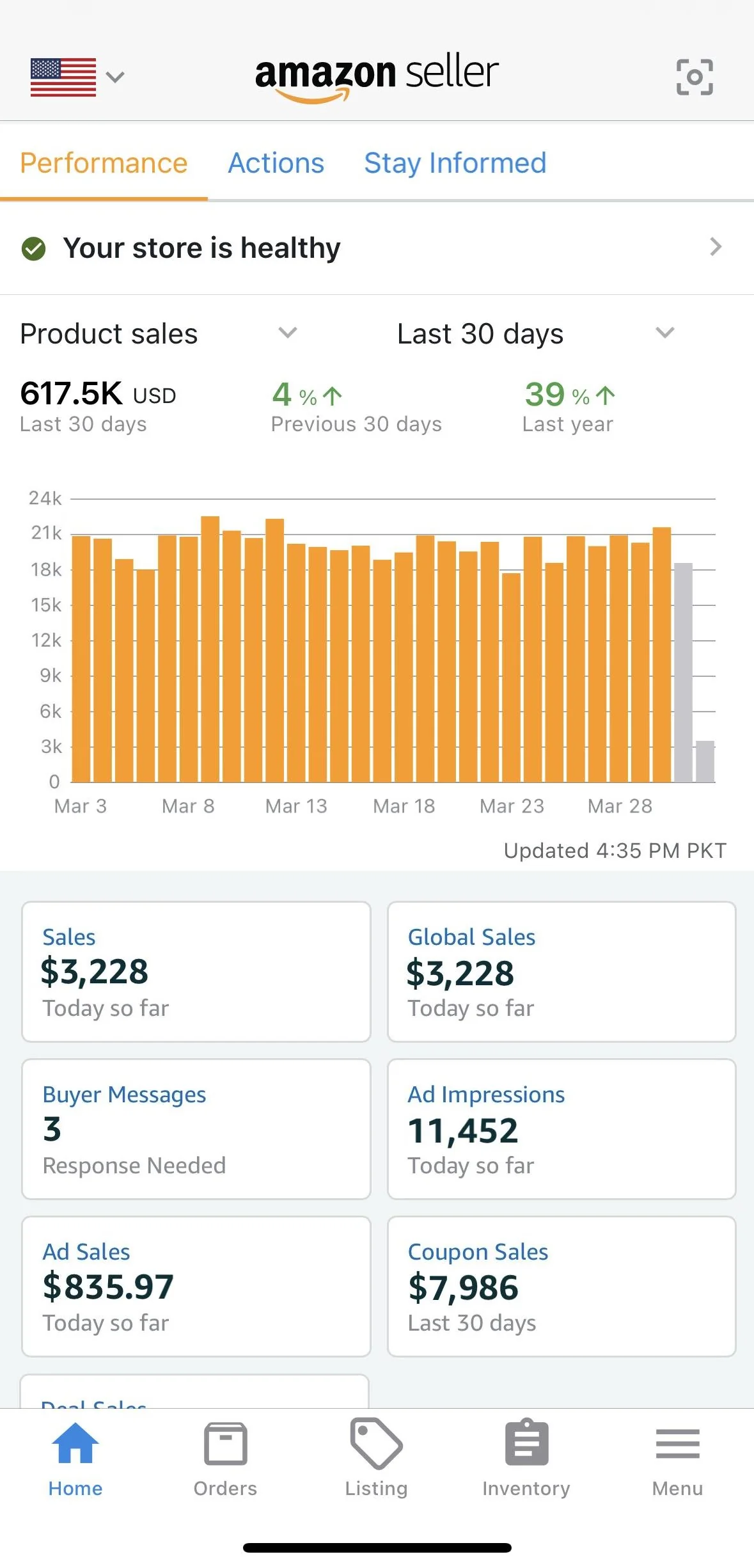
DSP was the layer that extended that growth beyond search — building brand awareness and recovering shoppers who had viewed but not yet purchased. Here's how the brand described working with our team:
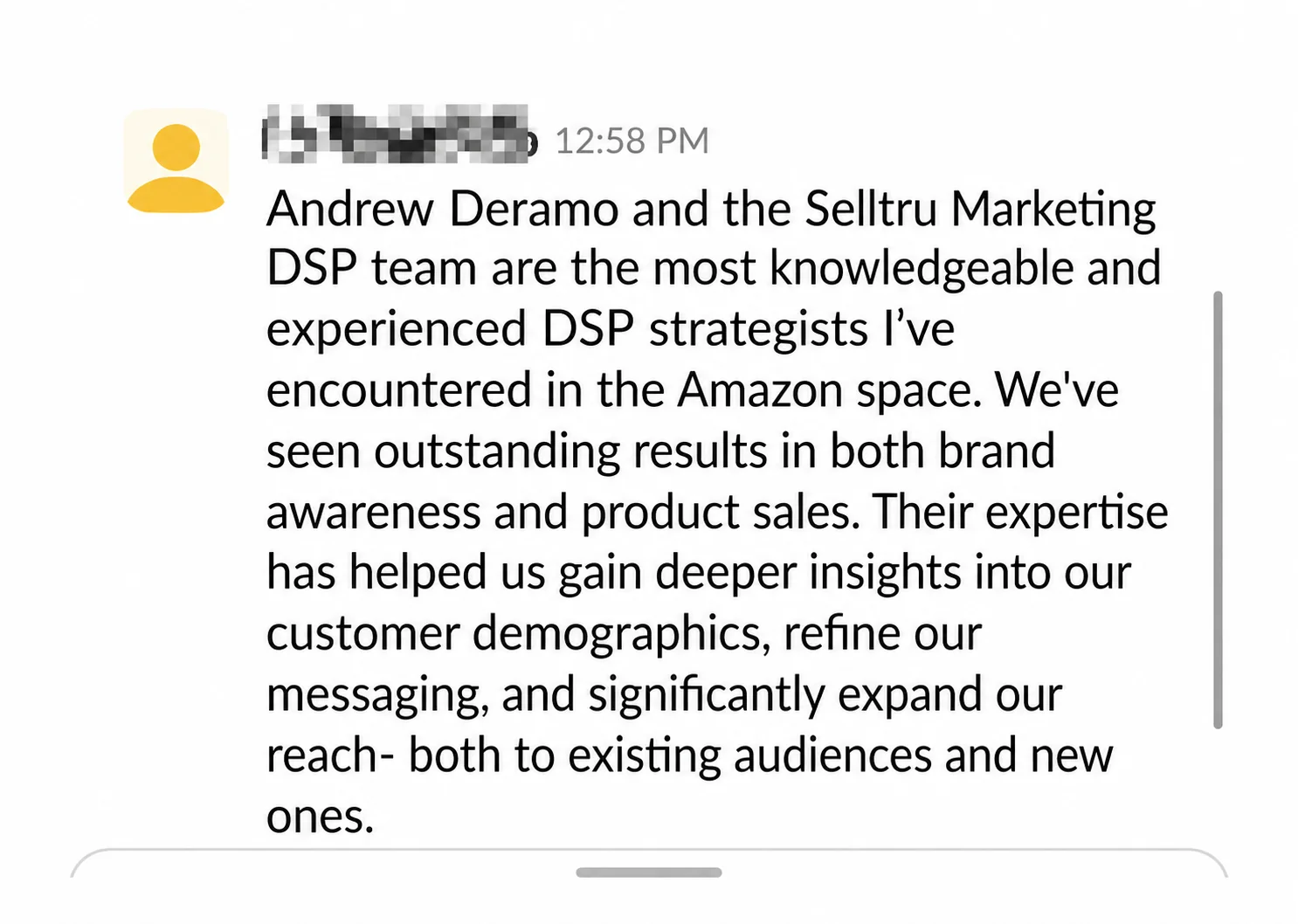
"Andrew Deramo and the SellTru Marketing DSP team are the most knowledgeable and experienced DSP strategists I've encountered in the Amazon space. We've seen outstanding results in both brand awareness and product sales. Their expertise has helped us gain deeper insights into our customer demographics, refine our messaging, and significantly expand our reach — both to existing audiences and new ones."
— Verified SellTru DSP client
How to Get Started
Here's the catch that surprises most sellers: DSP isn't part of Seller Central. You can't just flip it on the way you do Sponsored Products. There are three ways in, and the right one depends on your budget and how hands-on you want to be:
- Amazon self-service DSP. Amazon has opened a self-service console with no formal minimum spend, so you run the campaigns yourself. The trade-off is a steep learning curve — the platform is complex and audience strategy is easy to get wrong.
- Amazon managed service. Amazon's own team runs it for you, but the minimum is typically around $50,000/month, which prices out most growing brands.
- Through an agency. An agency with a DSP seat lets you start far lower — often around $5,000/month — with hands-on optimization. For most brands this is the realistic on-ramp: a lower floor than managed service, without the self-service learning curve.
Whichever path you choose, audience strategy is where DSP is won or lost — the targeting decisions matter far more than which console you log into. If you want a sense of how DSP fits alongside the rest of your ad stack, our Amazon marketing services page walks through how the pieces connect.
The bottom line: Amazon DSP is the audience-based half of Amazon advertising — best deployed as a retargeting and demand-building extension once your Sponsored Products and Sponsored Brands are already profitable. Get to 100+ reviews, dial in a healthy ACoS, then layer DSP on top at around a quarter of your PPC spend. Test it at the stage that matches your product's maturity, and treat it as an amplifier — not a rescue plan.
Amazon DSP FAQs
Is Amazon DSP worth it?
For brands with a profitable PPC foundation and products with 100+ reviews, yes — DSP is the most effective way to recover shoppers who viewed but didn't buy and to reach new, high-intent audiences. For brands that haven't dialed in Sponsored Products and Sponsored Brands yet, it's usually too early; DSP amplifies an existing engine rather than replacing one.
What is the minimum spend for Amazon DSP?
It depends on the path. Amazon's self-service console has no formal minimum, Amazon's managed service typically requires around $50,000/month, and most agencies will run DSP for roughly $5,000/month. We generally budget DSP at about 20–25% of a brand's existing PPC spend.
What's the difference between Amazon DSP and Sponsored Display?
Sponsored Display lives in Seller Central, is billed per click, and offers simplified audience targeting. Amazon DSP is the full programmatic platform — deeper audience controls, CPM billing, and display, video, and audio inventory across and beyond Amazon. Sponsored Display is essentially the entry-level version of what DSP does at full scale.
Do I need an agency to run Amazon DSP?
Not strictly — Amazon's self-service option lets you run it yourself. But the platform is complex and Amazon's managed-service minimums are high, so most growing brands partner with an agency to access DSP at a lower spend floor with hands-on audience strategy.
Can I use Amazon DSP if I don't sell on Amazon?
Yes. DSP is open to brands that don't sell on Amazon at all, since it can drive traffic to any destination. That's a topic for its own post — here we've focused on brands already selling on Amazon.
Wondering if DSP is your next move?
We'll audit your current Amazon ad structure for free, tell you honestly whether you're ready for DSP, and show you exactly where retargeting could recover lost conversions.
Get a Free AuditAbout SellTru: We're a full-service Amazon and Walmart advertising agency that manages Sponsored Products, Sponsored Brands, and programmatic DSP campaigns for growing brands — the benchmarks in this article come from accounts we run day to day.
Have experience with this? The SellTru blog accepts guest posts from Amazon sellers, agency pros, and ecommerce operators. See our submission guidelines →