Amazon PPC
Rethinking Amazon PPC: Beyond ACoS to TACoS for Maximum Profitability
Optimizing to your advertising cost of sale — your ACoS — is the completely wrong way to run Amazon PPC. I say that as someone who has watched hundreds of accounts, and the single most common mistake I see, from solo sellers to brands managing thousands of SKUs, is an obsession with ACoS. It drives me a little crazy, because chasing a lower ACoS is often the very thing keeping an account from scaling. Let me rewire how you think about this, because once the concept clicks, it changes the game.
Why ACoS Is the Wrong North Star
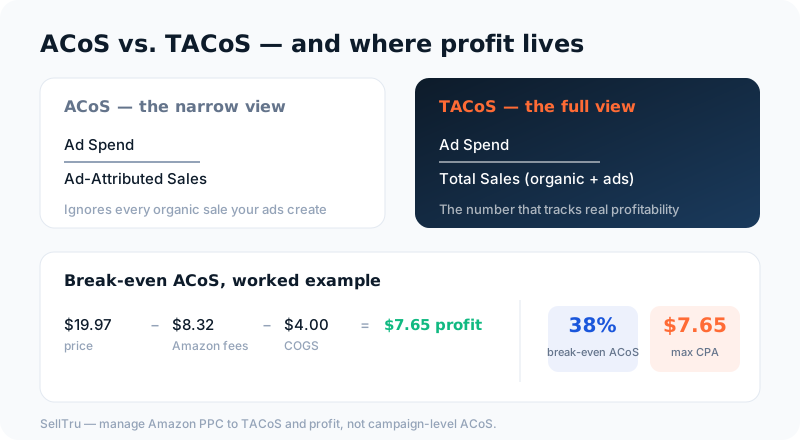
Start with the definitions, because the difference is everything. ACoS is your ad spend divided by your ad-attributed sales — it only ever looks at advertising in isolation. TACoS, your total advertising cost of sale, is your ad spend divided by your total sales: organic and advertising together. ACoS sees a sliver of your business. TACoS sees the whole thing.
That distinction matters because your ads do far more than generate the sales Amazon attributes to them. They drive velocity and conversions, and Amazon rewards products with high conversion rates and high sales velocity by lifting their organic rank. When you manage to ACoS, you cut the exact spend that was quietly building your organic position — and you never see the damage, because organic sales don't show up in an ACoS number. If you want the full breakdown of the metric and healthy benchmarks by stage, we cover that in our guide to Amazon TACoS.
The core shift: ACoS can be as high as it wants to be. Sometimes a high ACoS is the thing lowering your TACoS — and TACoS is what tracks real profit.
The 80/20 Rule That Simplifies Everything
Before we touch targets, focus. Roughly 20% of your products drive 80% of your revenue. The same holds for your campaigns and your search terms — a small handful do almost all the work. Most advertisers spread themselves thin trying to advertise every product and run every strategy at once. Don't. Pour budget and attention into the 20% that's already winning: the products that convert, the campaigns that produce, the search terms that sell.
In practice, those winning campaigns are usually Sponsored Products, because that's what drives volume and conversion. Concentrate there and PPC gets dramatically simpler — for most accounts, real management is about 30 minutes a week once the structure is right. If you want the campaign types we lean on, see our rundown of the best Amazon PPC strategies for 2026.
A 150% ACoS Campaign That Made Us More Money
Here's the example I come back to constantly. We sell eyelid wipes, and one of our highest-converting search terms was "sty treatment." We built an exact-match campaign on that single term. It ran at 150% ACoS. Almost everyone reading this would have paused it on sight.
We didn't — and here's what it actually did. That campaign drove four sales a day at a conversion rate above 30%. Amazon noticed. It lifted our organic ranking not just for "sty treatment" but for hundreds of related keywords across the entire "sty" silo. Our organic sales climbed, our total advertising cost of sale went down, and our profit went up. The campaign looked like a loser at the campaign level and was a clear winner at the account level. That's the whole point: don't use individual campaign ACoS to make big decisions. We cover how to tell a productive high ACoS from a wasteful one — and when to actually bring it down — in our guide to reducing a high ACoS without cutting spend.
Know Your Break-Even ACoS and Max CPA
Ignoring campaign-level ACoS doesn't mean flying blind. You still need a target, and it's built on two numbers every seller should know cold for each ASIN: break-even ACoS and maximum cost per acquisition.
The math is simple. Take your retail price, subtract your Amazon referral fee, subtract your FBA cost, subtract your cost of goods — what's left is your profit. Divide that profit by your sale price and you have your margin before ad spend, which is also your break-even ACoS. That same profit figure in dollars is your maximum cost per acquisition: the most you can pay to acquire a sale and still break even.
Worked example: A product sells for $19.97. Amazon fees (referral + FBA) run $8.32, COGS is $4.00. Profit = $19.97 − $8.32 − $4.00 = $7.65. That's a max CPA of $7.65 and a break-even ACoS of about 38% ($7.65 ÷ $19.97).
Setting Your Target: Consumables vs. Commodities
Your target ACoS lives around that break-even number, and which side of it you land on depends on what you sell. If I sell a consumable — something people reorder — I'll deliberately run above break-even. Going aggressive lifts organic rank and acquires customers who come back and buy again and again. I'm willing to lose a little on the front end because I know profit comes on the back end, over the lifetime of that customer.
That's the mistake that costs sellers the most: being cheap up front because they don't see the back end. The first sale acquires the customer; the profit shows up when they buy from you the second, fifth, and tenth time. I ran an optometry practice for years — imagine only ever chasing new patients and never seeing anyone twice. Instead, before a patient left, we'd already booked next year's exam and handed them the card. We assumed they'd come back, and our retention was huge. Amazon consumables work the same way. Sell a true commodity or a one-time purchase, though, and you flip it: protect your front-end profit and target at or below break-even, because there's no reorder to reward the aggression.
The Bottom Line: Manage to TACoS, Not ACoS
Here's your playbook. Calculate your max CPA and break-even ACoS for each product. Set a target ACoS around break-even — above it for consumables, at or below it for commodities. Then stop watching individual campaign ACoS and start watching three things at the account level: your TACoS, your organic rank, and your conversion rate. A high-converting keyword can carry a 150% ACoS and still be your most profitable line item, because of everything it does to organic. Manage the whole business, not the sliver. That's how PPC actually drives profit — and it's the philosophy behind how we run Amazon PPC management at SellTru.
ACoS is a rear-view mirror on one campaign. TACoS is the windshield on your entire business — and profit lives on the back end, not the first click.
Is a "bad" ACoS hiding your best campaigns?
We'll audit your account for the high-ACoS campaigns quietly driving down your TACoS — and the low-ACoS ones that aren't building anything. Free, no obligation, done in about 15 minutes.
Get a Free AuditHave experience with this? The SellTru blog accepts guest posts from Amazon sellers, agency pros, and ecommerce operators. See our submission guidelines →