Amazon PPC
Best Amazon PPC Strategies 2026
Amazon PPC has changed faster over the past year than at almost any point I can remember. Strategies that printed money in 2024 are quietly bleeding budget now, and a few tactics that used to be afterthoughts have become the highest-selling, most profitable campaigns in our portfolio. I run one of the larger ad operations on the platform — over $5 million in monthly Amazon PPC ad spend across our managed accounts — and I'm a verified Amazon Ads partner. This post walks through the five campaign types my team and I are seeing work best right now, in 2026, with real examples from accounts we manage.
I pulled these five by polling my senior strategists at SellTru about the trends they're actually seeing across their accounts this year — so this is current, not recycled advice from two years ago. If you only do one thing after reading, audit your account against this list and see how many of these you're missing.
The five Amazon PPC strategies working best in 2026:
- Product targeting campaigns — now a top sales and profit driver, not a side play.
- Sponsored Brand video + product targeting — the highest-leverage combo on the platform right now.
- Refined category targeting — target a whole category, then narrow by competitor rating and price.
- Properly structured auto campaigns — a profit center, not just keyword research.
- Audience bid adjusters — bid more on shoppers most likely to buy.
1. Product Targeting Campaigns
Stick with me, because I know this sounds basic. Over the past 15 months, product targeting went from a small side endeavor to, for many of our accounts, the single highest-selling and most profitable campaign type. Back in 2024 and early 2025, keyword targeting was everything — a lot of accounts didn't run anything else. Today, running keyword targeting alone is a genuine mistake.
The key insight most sellers miss: a product targeting campaign doesn't only show up on product detail pages. Amazon will serve those ads in search results too. It doesn't restrict product-targeted ads to listings and keyword-targeted ads to search — it can show either placement for either campaign. Some of our best-performing search placements come from campaigns that only use product targeting. On top of the profitability, product targeting also feeds organic keyword ranking.
That organic lift is exactly why we do not judge campaigns by ACoS alone. It is the reasoning behind managing Amazon PPC to TACoS for profitability.
Real example: On one biohacking account — a premium, high-priced product — our top sales campaign is a Sponsored Products campaign using exact product targeting against the highest-priced ASINs in the category. The logic: shoppers willing to pay top dollar for a competitor are willing to pay top dollar for us. Result: 12% ACOS and the most sales of any campaign in the account.
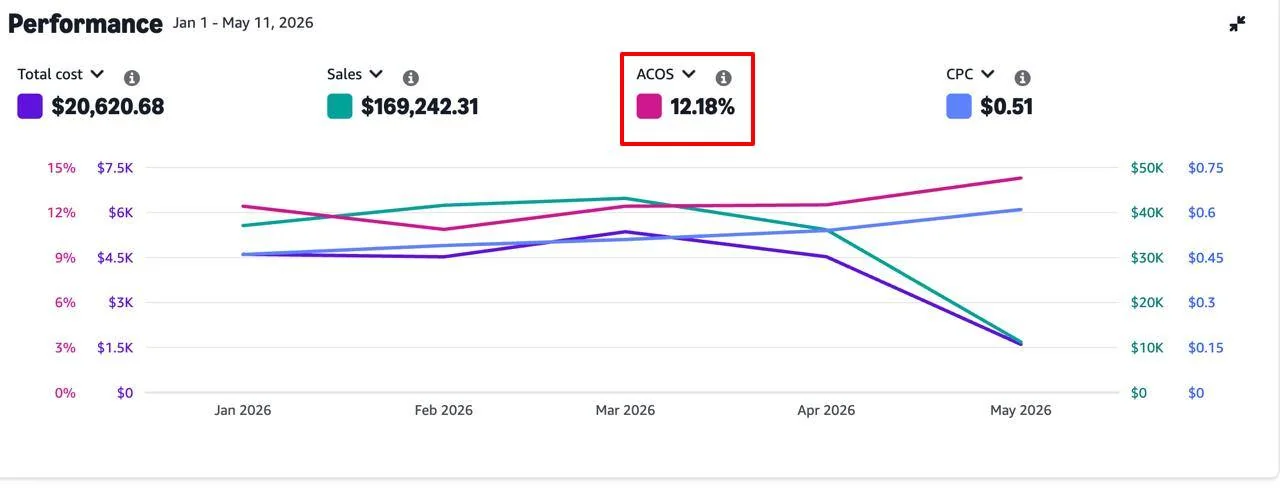
This isn't an anomaly. More and more of our accounts are pulling the majority of their sales from product targeting. If you want a refresher on choosing the right targets, our Amazon keyword research guide covers how we build target lists.
2. Sponsored Brand Video Campaigns
Sponsored Brand video is working better than ever. We started leaning into this format in mid-2025, and in 2026 it's reached a new level — Amazon is pushing it hard, and with strong video creative the results can be exceptional.
The real magic is combining the two trends above: Sponsored Brand video plus product targeting. It's a match made in heaven. On one account, our top campaign by sales is a Sponsored Brand video campaign with product targeting aimed at the single top competitor — low ACOS, profitable, and generating a huge volume of sales, so we pump as much spend into it as we can. On another account, our top two campaigns by sales are both Sponsored Brand video with product targeting — one against high-volume competitors, one against a single competitor's listing.
Put product targeting and Sponsored Brand video together and you get a "super 2026 campaign" that rides both of the platform's strongest current trends at once. This combination came up over and over when I talked to our strategists about what's working. If you're weighing the ad types, our breakdown of Sponsored Products vs. Sponsored Brands is a good companion read.
3. Category Targeting (Especially Refined)
You may have already spotted the pattern: over the past 12–18 months, Amazon has been moving from narrow targeting to broad targeting as the thing that performs best. This mirrors what happened on Meta around 2022–2023 and on Google shortly after — the platforms shifted away from narrow, single, exact targeting toward broad targeting paired with good conversion signals and solid optimization. Amazon is going through its own version of that transition: exact-match single-keyword targeting used to be 90% of spend on many brands; now category targeting, auto campaigns, broad match, and phrase match are carrying more of the load.
Category targeting is how you ride that wave — and refined category targeting is the sharpest version. Instead of targeting a keyword or a single product, you target an entire category and then narrow it. Say you're targeting "dog joint supplements." You can tell Amazon: only advertise me against brands rated under four stars and priced above $30 — so your offer is demonstrably better than the listing your ad appears on. That puts your ad where you're more likely to win the click and the sale.
On one account, a refined category targeting campaign (narrowed by max average star rating and minimum price) had the lowest ACOS of any of the account's top campaigns — a great way to get lean, efficient sales. On our high-growth example account, the second and third highest-selling campaigns overall were category targeting, sitting right behind product targeting.
4. Auto Campaigns (Set Up Properly)
I know auto campaigns sound boring, and most sellers already run them — but most aren't setting them up to actually perform. An auto campaign essentially tells Amazon, "I won't specify the targeting; just advertise this product where you think it fits." But it's not really that hands-off: you can add negative product and negative keyword targets, and you can choose among the four match types — close match, loose match, substitutes, and complements.
Auto campaigns used to be pure research — a way to let Amazon find good targets that you'd later promote elsewhere. In 2026 they're a profit center in their own right. On one account, an auto campaign on close match is the top-selling campaign at a very reasonable ACOS. On another, an auto campaign on substitutes is the top seller at an 11.5% ACOS. The difference is structure and negatives, not luck — see our full guide to Amazon negative keywords for the exact workflow.
5. Audience Bid-Adjuster Campaigns
This isn't AMC audience targeting — it's the audience bid adjuster inside Sponsored Products, which lets you raise your bid for the audience Amazon labels "high likelihood to purchase based on recent shopping activity." In plain terms: bid more when the shopper is more likely to buy. It rolled out a couple of months ago, we started testing it, and it works.
The numbers: On one account the overall average ACOS is 43%, but the audience-targeting campaign runs at 23%. On another, the account average is 32% versus 22% for audience targeting. On a third, the account averages ~33–34% ACOS while the audience-targeting campaign sits at 19%. On a fourth, account average 27% versus 11% on audience targeting. We now run audience bid adjusters on nearly every campaign in some accounts.
Bonus Campaigns Worth Testing
Scavenger campaigns. Set a very low bid — around a tenth of Amazon's suggested bid — across a large set of keywords, then wait for competitors to run out of bid or budget. When their campaigns are "bleeding in the corner," yours pounces and picks up cheap, lean sales.
Retargeting. In Sponsored Products you can run a self-targeted product placement campaign: build a product targeting campaign but target the very same product you're advertising. That functions as near-instant retargeting and can be extremely lean. Sponsored Display retargeting — both purchase and views retargeting — also works well right now.
Keyword themes. Amazon now lets you target keyword themes (what we used to call shopper intent). When you set up a Sponsored Products campaign, the keyword section offers "add theme" with suggestions. Targeting themes is performing well in 2026.
Amazon PPC Strategy FAQ
What is the best Amazon PPC strategy in 2026?
In 2026 the highest-performing Amazon PPC strategies are product targeting campaigns, Sponsored Brand video paired with product targeting, refined category targeting, properly structured auto campaigns, and Sponsored Products audience bid adjusters. The common thread is a shift away from narrow exact-match keyword targeting toward broader targeting backed by smart campaign structure and strong creative.
Is keyword targeting still worth it on Amazon in 2026?
Keyword targeting still has a place, but relying on it alone is a mistake in 2026. Product targeting, category targeting, and auto campaigns now drive a large share of sales and profit for many accounts, and they frequently outperform exact-match-only keyword campaigns.
What is refined category targeting on Amazon?
Refined category targeting means targeting an entire product category and then narrowing it by attributes like competitor star rating and price — for example, only showing your ad against brands rated under four stars and priced above $30 — so your offer is stronger than the listing where your ad appears.
What is an Amazon audience bid adjuster?
The audience bid adjuster inside Sponsored Products lets you raise your bid for shoppers Amazon flags as "high likelihood to purchase based on recent shopping activity." In testing across multiple accounts, it produced a meaningfully lower ACOS than the account average.
The throughline across all five is the same shift Meta and Google already went through: broad targeting, smart structure, and good creative are beating narrow, manual, exact targeting. If your account is still 90% exact-match keyword campaigns, you're leaving both sales and efficiency on the table — and almost certainly running a higher ACOS than you need to. Start by adding product targeting and a Sponsored Brand video campaign, then layer in refined category targeting and audience bid adjusters from there.
One more note on timing: every strategy above gets more expensive and more valuable in Q4. If the holidays are on your horizon, work through our Amazon Q4 prep checklist before the September inventory cutoffs pass you by.
Is your PPC stuck in 2024?
We'll audit your campaign mix for free and show you exactly where product targeting, Sponsored Brand video, and refined category targeting can cut your ACOS and grow sales.
Get a Free AuditHave experience with this? The SellTru blog accepts guest posts from Amazon sellers, agency pros, and ecommerce operators. See our submission guidelines →