Amazon PPC
Amazon PPC for Supplement Brands (2026)
If you run an established supplement brand on Amazon, you have probably felt this: the product sells, the reviews are decent, there is real brand awareness, and yet every year the ad account gets harder to control. Spend creeps up. ACoS drifts. And you cannot say with confidence which campaigns are actually growing the business versus quietly eating your margin. This post is for that brand, the one doing $500K to $10M a year on Amazon, not the one still deciding when to flip ads on.
Here is the uncomfortable starting point. In supplements, ads will not save a weak offer. They just expose the problem in much greater detail, and they cost you a lot of money doing it.
Why does Amazon PPC keep getting harder for supplement brands?
Supplements sit in one of the most expensive, competitive, and margin-sensitive corners of Amazon, so paid traffic punishes any weakness in your foundation instead of covering for it. The category data backs this up. In Q1 2026, Health & Household carried the highest cost-per-click of any major Amazon category at $2.17, up nearly 6% year over year. The same category converts well, around a 30.2% conversion rate, which is exactly why so many brands keep bidding it up. On the demand-gen side, Triple Whale's 2025 benchmarks put Health & Wellness at one of the highest CPMs at $11.13 against an average order value of just $37.73. High click costs, high impression costs, modest order values. That is a tight margin environment, and tight margins are unforgiving when the account is loose.
The bottom line up front: Profitable PPC in supplements starts before the first campaign is ever built. The listing has to be believable, the claims compliant, and the economics understood. Turn ads on and Amazon will happily spend your money. The only question is whether your foundation turns that traffic into profitable customers.
Is it a traffic problem or a traffic-quality problem?
Most supplement brands do not have a traffic problem. They have a traffic-quality problem. It is easy to make Amazon spend more and drive more clicks. The hard part is making sure those clicks are the right clicks, on the right terms, at a price you can actually afford.
This is where a lot of brands get into trouble: they mistake high sales for profitable sales. Your ads can report that they drove $80,000 this month, but at the cost of what? If the margin is not there, the number does not matter. Chasing the top-line sales figure instead of the margin behind it is the single most common mistake I see, and broad match terms are usually where the leak lives, because that is where the easy volume is.
What does a messy supplement PPC account actually look like?
It usually looks healthy on the surface and broken underneath: spend creeping up, click-through falling, and ACoS climbing while the top-line sales number still looks fine. Here is a real one. One supplement account I took over was already doing roughly $75K to $85K a month. The product was good. The problem was that the PPC structure was far too loose. Broad terms were spending way too much, and when I looked at the account history, bids were being adjusted about once a week instead of daily. The previous management was watching sales volume and little else.
The damage showed up clearly in one top-of-search campaign: ACoS had drifted from around 24% to about 41%. At the same time, bids were rising, click-through rate was falling, and impressions on important terms had collapsed from roughly 15,000 to about 6,000. That tells a better story than any industry benchmark, because it shows what actually happens inside a messy account. The problem was not just high CPCs. The account was losing control of its traffic quality.
The fix was not simply to lower the bids. That is what most people do, and it just creates another problem. The real fix was rebuilding around intent: protect branded search, separate high-intent non-branded keywords from broad research terms, get product targeting under control, and manage the account against margin instead of total ad sales.
How should you structure Amazon PPC for a supplement brand?
Structure it in one order and run it from the top down: Profit, then Foundation, then Traffic, then Scale. Most brands run it backwards by starting with scale, which is exactly why the account gets messy and the margin disappears.
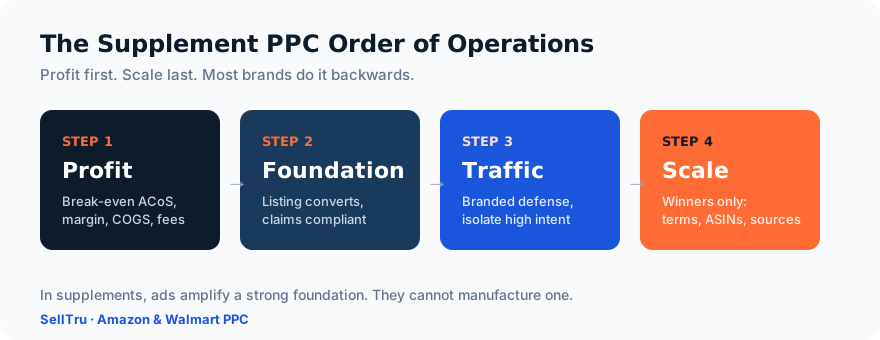
- Profit first. Before touching a single campaign, get into the numbers. What is the break-even ACoS? What is the target margin? What are the cost of goods and the fees? You cannot manage an account to profit if you do not know what profit looks like.
- Foundation. Audit the listing itself, the conversion rate, reviews, images, positioning, and your Subscribe & Save strategy. If the page does not convert, ads will not fix it, they will only make it worse. A listing that actually converts is the prerequisite, not an afterthought.
- Traffic structure. Break the account into a clean structure: branded search, high-intent non-branded, competitor targeting, and discovery. Each of those buckets has a different job and a different acceptable cost.
- Defend your brand terms. Your branded keywords are your highest-intent and most profitable terms. If you are not protecting them, competitors will take advantage. These become your core growth, not an afterthought.
- Scale your winners. Here is the distinction that matters: I do not scale campaigns, I scale profitable search behavior. Not the whole campaign because the totals look good, but the individual search terms, ASIN targets, and traffic sources that have already proven they can generate profit.
What do most agencies get wrong with supplement PPC?
Most agencies get supplements wrong because they run the same playbook they would use in any other category. That might work in a less competitive space, but supplements are different. The search volume is high, the competition is fierce, and you have to look at the whole picture. The same margin-first logic applies in other low-AOV consumable categories; see our guide to Amazon PPC for beverage & CPG brands for how this plays out with drinks, powders, and snacks.
The typical approach is to walk in asking, "How do I lower the ACoS?" and then stare only at the ads dashboard. That is the wrong lens. The goal is not to make the ads dashboard look better. The goal is to make the account healthier as a whole. That means starting with the economics, the offer, the listing, and the customer intent, and watching TACoS and contribution margin rather than just chasing a smaller ACoS number in isolation.
What's a good ACoS for a supplement brand?
There is no universal "good" ACoS for supplements, so be careful with generic benchmarks. A healthy number depends on your margin, price point, repeat-purchase rate, Subscribe & Save penetration, promo strategy, and where the product sits in its lifecycle. The real benchmark is not "What does the industry average?" It is "What can this specific brand afford to pay for a customer and still make money?"
So the numbers I care about most are not just CPC and ACoS. They are TACoS, contribution margin, branded versus non-branded performance, Subscribe & Save behavior, conversion rate, review strength, and how much spend is being wasted on low-intent broad terms. That is where the truth usually is.
What else do supplement brands ask about Amazon PPC?
What's a good ACoS for supplement brands on Amazon?
There is no single number. Most established supplement brands target roughly 20% to 35% on profitable terms, but the right figure depends on your margin, price point, repeat-purchase rate, and Subscribe & Save penetration. The real benchmark is what you can pay to acquire a customer and still make money.
Should supplement brands use auto campaigns?
Use them carefully and in a controlled way. Auto campaigns are useful for discovering new keywords, but they will also spend on irrelevant terms if you let them. Run them for discovery with tight negatives, not as a core part of the strategy.
Why is my supplement ACoS rising even though sales are steady?
Usually it is a mix of rising category CPCs and a loose account: broad terms overspending, bids adjusted too infrequently, and branded search left undefended. The fix is rebuilding around intent and managing to margin, not simply lowering every bid.
Do I need an agency to run supplement PPC?
Not necessarily, but supplements are competitive and margin-sensitive enough that structural mistakes get expensive fast. If you want a second set of eyes, our Amazon PPC service for supplement brands covers exactly this: compliance-aware ad strategy, ingredient-specific targeting, and subscriber acquisition tracked as a primary metric.
The bottom line: in supplements you can have a product that sells and still watch PPC quietly drain the profit out of the business if the account is not structured tightly. Ads amplify a strong foundation. They cannot manufacture one. Get the order right, profit before scale, and the account gets healthier instead of just bigger.
Before you spend another dollar, get your supplement account audited
We'll show you where your ad spend is leaking, which campaigns are actually driving profitable growth, and whether your PPC is built around margin or just sales. We review branded versus non-branded performance, wasted broad and auto spend, high-intent keyword opportunities, and your TACoS and margin alignment.
Get a Free AuditHave experience with this? The SellTru blog accepts guest posts from Amazon sellers, agency pros, and ecommerce operators. See our submission guidelines →