Amazon Strategy
How to Judge Marketplace Agency Reviews Before You Hire
People type "marketplace agency reviews" because the proposals all sound careful. The pages that come back are not one kind of company. Some are operators who log into Seller Central and the ad console. Some sell product reviews. Some are listicles. A star does not tell those apart, and it does not tell you whether the firm did the job you are about to buy.
SellTru is an agency, and we publish this. Weigh it that way. The figures below are the ones already on the site, not quotes we are adding here: $150M+ in marketplace sales managed, 200+ brands, 90% client retention, and a 45% average ACOS reduction in the first 90 days. We are an Amazon Ads Partner Network member and a Walmart Marketplace Partner, and the site shows Upwork Top Rated Plus. The Walmart Connect page states 3x average Year 1 growth for the accounts in that set. None of that is a forecast for your catalog, and this post does not add a client name or a testimonial.
The search mixes up two different businesses
Suggestions under that query include marketplace agencies and phrases like "product review service" and "paid product reviews." Those are different purchases.
A marketplace agency logs into Seller Central, Vendor Central, Walmart Seller Center, or the ad consoles and does the weekly work: listings, bids, inventory, and account health. A product-review service tries to put reviews on your listings. Amazon restricts incentivized reviews. A writeup that brags about review velocity or verified-purchase packages is a different service, and it can put the selling account at risk. If you need more reviews on a product, use the programs the marketplace offers. Do not hire that work because the page ranked for agency reviews.
Keep a review that names the work: Sponsored Products, a suppressed listing, a purchase order, WFS, or account health. If it could describe a web shop or a service that sells product-page stars, set it aside.
Where a review is worth opening
Open four places. Stop when you can describe three reviews out loud. A fourth rarely changes the decision. Fewer than three means you are out of public text, not finished.
The Google profile for the office they claim
Match the profile to the address on the site. Ours is 333 Las Olas Way, Fort Lauderdale, FL 33301, and we work nationwide from that office. A profile in a city the site never mentions is a different company, or a listing they do not control. Read the newest reviews. An old average does not describe who would log in next month.
A directory, if the reviewer is identifiable
A B2B directory helps when the review shows a company, a budget band, a date, and the project. A "verified reviewer" line with no revenue and no scope is a star. Write the budget down. A one-time project is not evidence about a monthly retainer.
A platform they actually sell on
If they sell on Upwork or a similar site, read the text under the badge. Top Rated Plus is a platform status. The site states that SellTru holds it. Open the written reviews anyway. A badge with no paragraph does not tell you the scope.
The agency's own site
Quotes on the agency site are ads unless the same story is on a third-party page. Screenshots we publish are on the case studies page, and they are not quotes. A "best agencies" article, including any on this blog, is an argument: use it for names, then test the names with reviews.
Six fields a useful review has to fill
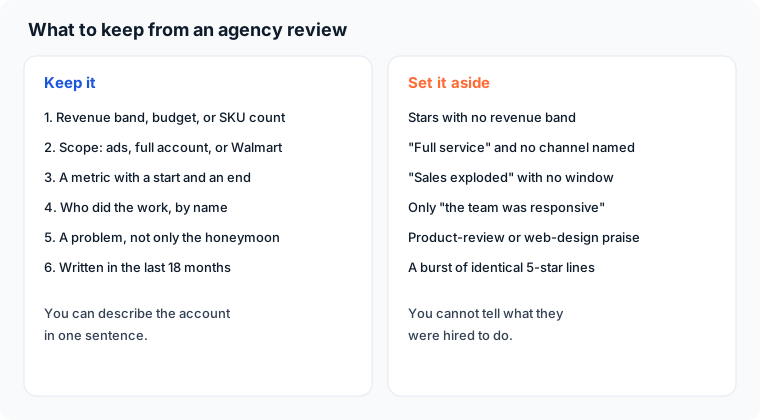
Write these next to every review you keep. If you cannot fill three, it will not help you choose.
- Size. A revenue band, an ad budget, or a SKU count. "They helped our brand" fits a new seller and a much larger catalog. We work with brands doing $1M to $20M. Far outside that band is a different job.
- Scope. PPC only, the whole account, Walmart, Vendor Central, or a project. Amazon PPC management is search terms, negatives, bids, and budgets. Amazon account management adds listings, inventory, and account health. Stars for bid work do not mean Walmart was included.
- A metric and a window. Name the metric, the start, the end, and the weeks. "Sales exploded" is not that. Ask if total sales moved, or only ad-attributed sales. ACOS grades ads. TACoS grades ad spend against the whole account. Our 45% average ACOS reduction is a company figure for the first 90 days on the accounts behind the homepage stat. A round number with no window is a slogan until someone names the accounts.
- A person. A name, or a line between the salesperson and the manager. "The team was responsive" can mean one person holds too many accounts. Ask if they are still there, and if you would meet them before you sign.
- A problem. A suppression, a stockout, a missed launch, a fee they caught, a suspension they did not promise to overturn. The first month is the honeymoon. The useful sentence is what they did when the number went the wrong way.
- A date inside the last 18 months. The ad console, fees, and Walmart Connect move. A warm review from several years ago may describe a structure they no longer run. Prefer the newest three.
The keep test: in one sentence, you can say how big the account was, what the firm was hired to do, and what changed over a named period. If you cannot, you have a compliment, not a review.
What a Walmart review has to say
A lot of "full service" reviews are Amazon stories with Walmart added in the headline. Walmart is a different catalog, a different ad platform, and a different fulfillment choice. A review that never says Walmart Connect, WFS or seller-fulfilled, or the Buy Box did not test the work on the Walmart marketplace agency page.
If the review says they ran the same campaigns on both, ask what they changed for Walmart search. Shoppers there do not type the same queries. A review that only repeats an Amazon ACOS story is an Amazon review.
Keep the 3x figure in its box. The Walmart Connect agency page states 3x average Year 1 growth for the accounts in that set. That is a company figure, like the 45% ACOS average. It is not a review you can call, and it is not a rate to write into a contract. If another firm leads with a multiplier and will not name the accounts and the year, ask for the weekly work instead.
Red flags on the review page
One review can be noise. The pattern on the page is the finding.
- A burst. Many reviews in one week, then silence. Ask what email or offer produced them. Prompted reviews are a weaker signal than ones someone wrote on their own.
- Shared sentences. Three reviews that say the firm went above and beyond, and never mention a search term, a listing, a shipment, or a fee, came from a prompt. Count one, not three.
- The wrong product. Praise for social media, a website, or a vague SEO project, with no ad account, Buy Box, inventory, or account health. That is not proof they can run Sponsored Products the week after.
- A guarantee they are proud of. "They guaranteed page one," or "they promised reinstatement." Rank depends on the offer, price, inventory, and competitors. Reinstatement depends on Amazon. We do not guarantee rank, reinstatement, or a savings number. A firm that leads with one is showing you the pitch.
- Spend went up, and that is the whole story. A bigger ad budget can be a result, or a fee that rose with the spend. Look for total sales or profit. Why we use a flat retainer, and the ranges, are on the pricing guide. PPC-only fees are in what management costs.
- No trail. A first name, no company, no date, only on the agency site. It may be true. You cannot check it, so it does not count toward the three.
Want a second read on the reviews you kept?
Book a 30-minute call. Bring the three reviews, the proposal, or the fact that the public page was empty. The audit is free either way.
Book a free 30-minute strategy callWhen a $1M to $20M brand has almost no public reviews
Brands in this range often will not post. A competitor would see who runs the account, or the agreement forbids it. A short page means you ask. It is not, by itself, a warning, and it is not a reason to lower the standard. Ask for two references in your revenue band, on the channel you are hiring. An Amazon reference does not cover Walmart, and a Walmart reference does not cover Vendor Central.
Ask these, and do not let the tone of the call replace the answers:
- What was marketplace revenue, roughly, when you hired them?
- What was in the agreement, and what did your team still do every week?
- What changed in the first 90 days that you could see in the account, not only in a deck?
- Who did the work, and is that person still on the account?
- What did they refuse to do, or tell you was a bad idea?
- If you left tomorrow, could you keep the logins and the campaign history the same day?
Campaign history and the catalog should stay on accounts the brand owns. A warm reference who cannot get the ad account back is a bad reference. A quieter one who can point at the edits is a good one.
Ask for a redacted Amazon Ads change history, or a weekly note you can match to edits in the account. A monthly PDF does not show that anyone logged in. The same test applies to Walmart Connect. A company figure only counts when the accounts and the window are named. The averages on this site are defined that way. An undefined multiplier is a slogan, not a line for your contract. After the review holds up, settle scope in 12 questions before you sign.
What a review cannot decide
A review says someone liked the firm. It does not pick the scope. Hire PPC when listings, inventory, and account health are fine and the gap is the auction. Hire full account management when those fail in the same week. Walmart is its own scope. "Full service" in a review that never mentions it did not test it.
Hire when that weekly work is slipping and a founder is doing it at night. A warm review is not a reason to expect a new rank by Friday. We onboard for 90 days, then go month to month. You keep the selling accounts and the ad accounts, and the agency is a user you can remove. If you still cannot describe the work, you have a star, not a review. Use the first-call questions, the in-house cost comparison, and the worth-it math.
FAQ
Are marketplace agency reviews on Google reliable?
They help when the Google profile matches the office on the site and the review names the channel, the scope, and a result over a period. The star average is not the evidence. A burst of reviews in one week is weaker than three recent reviews you can describe.
What is the difference between a marketplace agency and a product review service?
A marketplace agency runs the selling account: listings, ads, inventory, and account health. A product review service tries to add reviews to a listing. Amazon restricts incentivized reviews. Review velocity is not account management.
Can you hire an agency that has few public reviews?
Yes, if they can show other proof. Brands doing $1M to $20M often skip public reviews. Ask for two references in your revenue band, and for a change history or weekly note you can verify. A short page is not proof either way.
Does an Amazon Ads Partner badge replace reviews?
No. Amazon Ads Partner Network membership means the firm is in Amazon's partner program. Walmart Marketplace Partner is the same kind of fact. Neither is an ACOS score. Read the reviews, or ask for references.
Read a review until you can describe the account. If you cannot, the star is not evidence. Bring the three you kept, or the fact that you could not keep any. We will tell you if the scope should be smaller than a retainer.
Bring the reviews, or the empty page.
Thirty minutes. We will read the proof the way this post describes, against your account, before anyone talks about a fee.
Get a Free Audit Book a free 30-minute strategy callHave experience with this? The SellTru blog accepts guest posts from Amazon sellers, agency pros, and ecommerce operators. See our submission guidelines →